

The current console choice is no longer about raw novelty. Sony and Microsoft now offer mature systems with strong game catalogs, refined software, and clearer identities, which makes the decision more practical than it was at launch.
For most buyers, the real question is not which machine is more powerful on paper. It is which ecosystem fits the way they buy games, share a living room, value older libraries, and think about online access, privacy, and long-term cost.
Two powerful consoles, two distinct philosophies
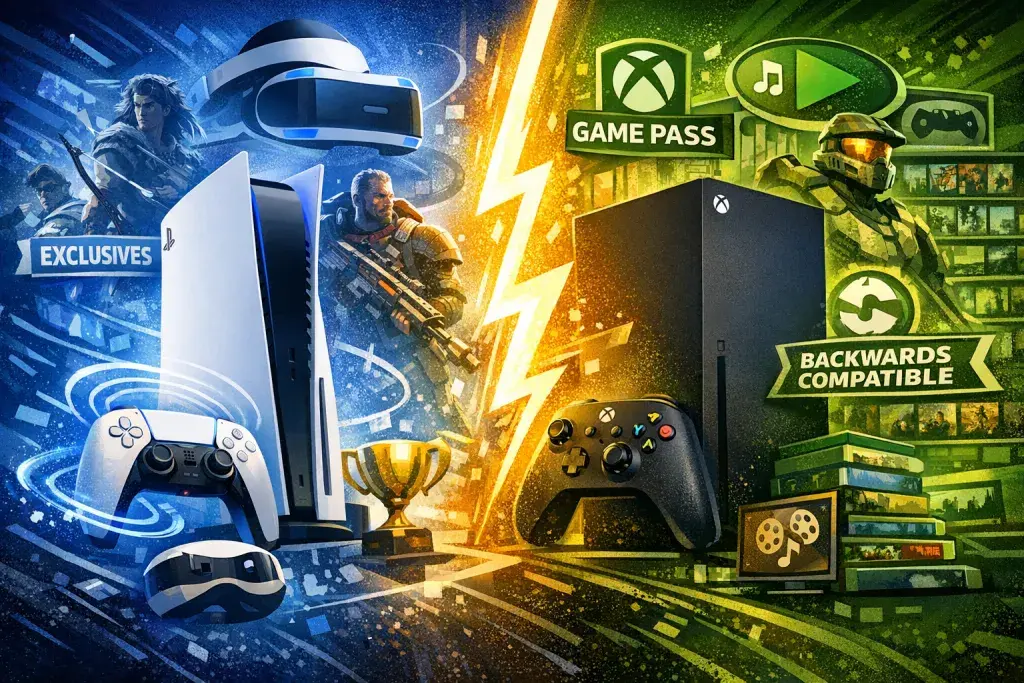
The Xbox Series X makes its strongest case through breadth and continuity. It emphasizes backwards compatibility, a familiar controller, and Game Pass, which lowers the barrier to trying a wide range of titles without buying each one outright. That model appeals to households that want flexibility, people with older Xbox libraries, and anyone who treats a console as a broad entertainment hub rather than a destination for a handful of major exclusives.
The PlayStation 5, by contrast, leans harder into sensory design and marquee first-party releases. The DualSense controller remains one of the clearest points of differentiation, with haptics and adaptive triggers that can materially change how certain games feel. Sony also holds an advantage for virtual reality through PlayStation VR2, a category Microsoft does not support natively on Xbox consoles.
Specs matter, but software and services matter more
On paper, both systems are capable 4K machines with fast SSD storage, modern CPUs, and support for high frame rates on compatible displays. In practice, differences in performance often depend less on headline specifications than on how individual games are optimized. That means most buyers will notice ecosystem features before they notice marginal technical gaps.
Subscriptions are central to that ecosystem choice. Xbox Game Pass has become one of Microsoft's most persuasive arguments because it combines a large catalog with day-one access to some new releases. PlayStation Plus takes a more tiered approach, with benefits that vary by plan, including access to a catalog and cloud features in some regions. The better value depends on habits: frequent sampling favors Game Pass, while buyers focused on Sony exclusives may find less reason to prioritize subscription depth.
Privacy, online reliability, and ownership still deserve scrutiny
Modern consoles are deeply connected devices. They collect usage data, encourage account-based purchasing, and tie many conveniences to cloud services. Buyers should pay attention to privacy settings, voice and activity sharing controls, and how much of their library depends on persistent online access. Convenience is real, but so is platform dependence.
Connection quality also affects the experience more than marketing often admits. Digital downloads are larger, multiplayer relies on stable routing, and server performance can vary by region. A reputable VPN can help some users improve route stability or reduce exposure to targeted attacks, though it is not a universal fix for latency and should be chosen carefully to avoid adding overhead.
Which console makes more sense now
The Xbox Series X is the stronger fit for buyers who value backwards compatibility, subscription value, and a more library-first approach. The PlayStation 5 stands out for those drawn to Sony's exclusives, more distinctive controller features, and access to console VR.
Neither choice is universally better. The PS5 is often the more curated, feature-forward proposition; the Series X is often the more accommodating and service-driven one. For a buyer deciding today, that distinction matters more than any spec sheet: choose the console whose catalog, services, and hardware features align with how you actually play.
