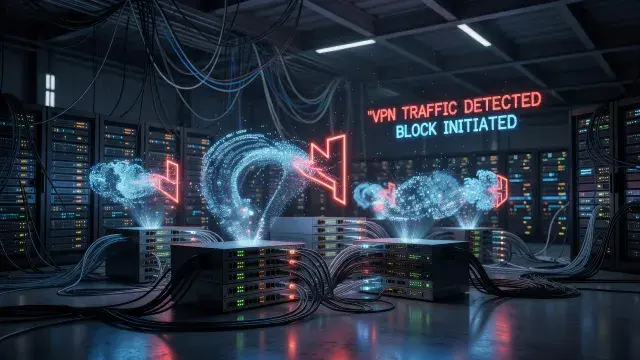

Every time a VPN connection succeeds, it has usually survived an invisible screening process. Networks run by internet providers, streaming platforms, employers, and governments routinely scan for the digital fingerprints of VPN traffic, and when they find them, they shut the door. This is not a glitch or an accident. It is a deliberate, increasingly sophisticated layer of network governance that sits at the intersection of business contracts, security policy, and in some cases, state control.
The simplest detection method is IP blacklisting. Commercial VPN services operate from known server addresses, many of which are publicly documented, so a network can simply refuse connections from that list, much like a doorman checking names against a registry. Because of this, providers that maintain large and frequently rotated server networks tend to slip past these blocks more reliably than smaller ones; readers comparing options can find more information on how server scale affects access in heavily filtered environments. But IP blocking is only the first layer of a much deeper system.
Beyond blacklists, networks use port blocking, closing off the specific channels that VPN protocols typically rely on, such as port 1194 for OpenVPN or 51820 for WireGuard. More advanced systems use Deep Packet Inspection, which examines the actual structure of data packets rather than just their origin. DPI can recognize the distinctive signature of encrypted VPN tunnels even when they travel over unconventional ports. Some networks go further still, applying behavioral analysis that flags suspicious patterns, such as one device suddenly exchanging data with dozens of unrelated international servers, a pattern rarely seen in ordinary browsing.
Why Institutions Choose to Restrict VPN Access
The motivations behind these blocks are rarely about hostility toward privacy itself. Streaming platforms, for instance, purchase distribution rights tied to specific countries or regions. A VPN that disguises a viewer's real location directly undermines those licensing agreements, which is why geoblocking remains one of the most consistent drivers of VPN detection. Corporate and educational networks have separate concerns: an unauthorized encrypted tunnel can bypass content filters, exfiltrate sensitive data, or open a path for malware, so blocking VPNs becomes a security safeguard rather than a restriction for its own sake.
Public networks in airports, cafes, and universities often impose similar limits simply to manage bandwidth fairly among many users. And in certain countries, VPN blocking is a matter of legal compliance, where network operators are required by law to restrict tools that could be used to bypass censorship or surveillance regimes. These layered motivations, commercial, security-driven, and political, explain why VPN blocking is not a single phenomenon but a patchwork of different enforcement systems with different goals.
The Rise of Obfuscation and the Ongoing Standoff
VPN providers have answered detection efforts with obfuscation, a set of techniques designed to make encrypted traffic indistinguishable from ordinary HTTPS browsing, which is almost never blocked outright. Some providers offer dedicated stealth or obfuscated server options, while certain protocol configurations, such as WireGuard routed through port 443, achieve a similar disguising effect. Traffic morphing tools go a step further, reshaping the size and timing of data packets so they resemble common web activity rather than a structured VPN tunnel.
None of this makes VPN blocking disappear. It simply shifts the contest to a new stage. As detection systems grow more precise, obfuscation techniques adapt in response, producing a continuous cycle rather than a final resolution. For everyday users, encountering a VPN block is not evidence of wrongdoing; it reflects the policies of the specific network being used. Trying alternate servers, switching protocols, or enabling a stealth mode where available often restores access. Understanding why these blocks exist, rather than simply reacting to them, helps users set realistic expectations about what a VPN can achieve in any given environment, and why the balance between open access and controlled networks remains unresolved.