
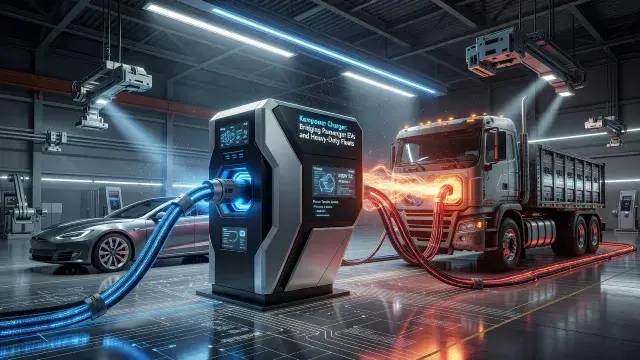
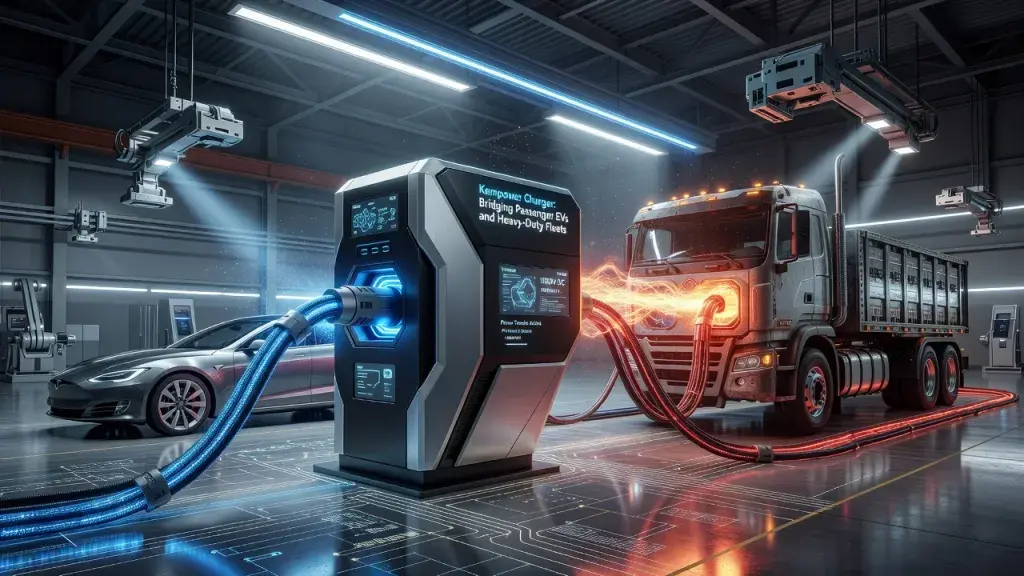
A single piece of hardware that can charge both a passenger sedan and a fully loaded semi-truck sounds like a modest engineering feat, but it addresses one of the thorniest problems in electric vehicle infrastructure planning. Kempower has unveiled the Mega Satellite Flex, a charger capable of delivering up to 560 kW through the established CCS standard or up to 1.2 MW through the emerging Megawatt Charging System, giving site operators a way to serve two very different vehicle classes from one installation.
The timing reflects where the industry actually stands. CCS remains the workhorse standard for electric cars and light commercial vehicles, while MCS is still being rolled out specifically for heavy trucks that need to recharge large battery packs in a limited window without idling for hours. Just as travelers increasingly rely on a vpn for public wifi to protect their connection in an unpredictable network environment, fleet operators need charging infrastructure flexible enough to handle unpredictable and mixed vehicle demand at a single site. Building two separate systems to cover both cases has been the default approach, and it's expensive and slow. vpn for public wifi
Why One Dispenser for Two Standards Matters
Charging site economics depend heavily on utilization. A plug that sits idle because it only serves one type of vehicle is a poor use of capital, land, and grid capacity. By supporting both CCS and MCS from a single dispenser, Kempower is betting that operators will get more consistent use out of each unit from the moment it's installed, rather than waiting for truck traffic to justify a dedicated megawatt-only buildout later. That's a meaningful shift in how charging sites can be planned along freight corridors and mixed-use travel stops.
The technical specifications support that flexibility. The Mega Satellite Flex handles up to 1,500 amps for MCS and 700 amps for CCS, with cable lengths of 5 meters for CCS and 2.7 meters for MCS to accommodate different vehicle geometries. It also works with newer 800-volt EV architectures, which are becoming more common as automakers push for faster charging times without proportionally larger cables and connectors.
Fitting Into Existing Charging Networks
Kempower designed the unit to integrate with its existing distributed charging architecture, meaning operators who already run Kempower systems won't need to rebuild their setups to add megawatt capability. That compatibility matters for an industry still figuring out how quickly to invest in MCS infrastructure, given that heavy-duty electric trucks are only beginning to reach meaningful volumes on public roads. An optional payment terminal rounds out the offering, positioning the charger for public and semi-public sites rather than purely private fleet depots.
The announcement came during Kempower's Unplug & Recharge event at ACT Expo, where the charger is being shown to customers and partners this week. Kempower expects the Mega Satellite Flex to reach the North American and European markets in July 2026, giving operators over a year to plan deployments around it. Whether that timeline holds will depend partly on how quickly truck manufacturers scale MCS-compatible vehicles, but the underlying strategy - one site, two standards - addresses a real bottleneck in how charging networks get built.
